
Wilmington Fence Types
Farm Fence Installation in the Wilmington Area, NC
Wood and vinyl rail fencing, split rail, post-and-rail, and equine fencing for properties in Pender and Brunswick counties.
- Lifetime Transferable Warranty
- Free On-Site Estimates
- Locally Owned & Operated
- Open 24 Hours, 7 Days
- Licensed & Insured
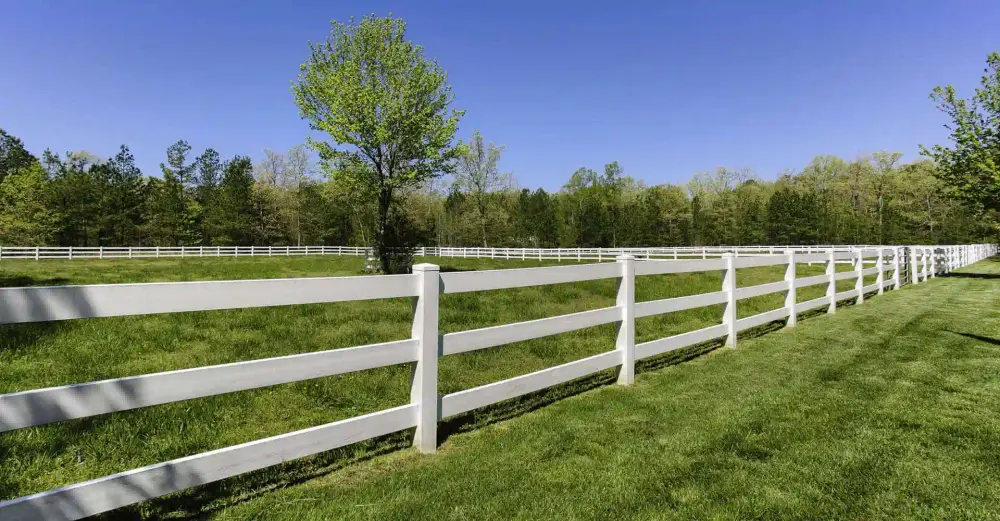
Farm & Rail Fencing in Wilmington
The rural stretches of Pender and Brunswick counties are a different job than a subdivision fence line. Burgaw, Rocky Point, Atkinson, Currie, and Willard to the north; Supply, Bolivia, Ash, and Longwood to the south. The parcels are larger, the ground is sandier, and the fence has to do actual work: contain animals, mark acreage boundaries, survive contact with horses or livestock that weigh a thousand pounds. This is genuine horse and small-farm country, and we install farm and rail fencing across all of it. We spec it for the land, not out of the catalog.
For property boundaries and decorative rural fencing, split rail is the natural-looking option. We install it in pressure-treated pine that stands up to this climate, slotting rails into routed posts that won’t pull loose over time. Be realistic about wood out here, though: constant humidity and hard sun age it faster than it ages inland, and it’ll gray and want resealing on a shorter cycle. If you want the look without that cycle, vinyl split rail and post-and-rail come in white, black, and wood-look finishes, never need painting or sealing, and don’t rot — which on a fence line measured in hundreds of feet is the difference between a weekend project every few years and none at all.
Equine fencing is a different spec than a property line fence. Horses lean, rub, and test fencing in ways a standard rail won’t hold up to. Our mesh-backed rail adds a woven wire layer between the horizontal rails — horses can’t push through, can’t get a hoof caught, and there are no barbs or sharp edges to cause injury. It’s the setup equine facilities and horse property owners trust. We install it in both wood and vinyl rail, in 3-rail and 4-rail configurations depending on the breed and the purpose of the enclosure.
Posts go in concrete on every job, and out here the reason is grip. Sandy loam drains fast, so water sitting at the post base isn’t usually what fails a rail line. What fails it is lateral force. A long rail run on open pasture has nothing between it and the wind, and this is a coast that takes direct hits from tropical systems — sustained wind working a fence line for hours, limbs coming down out of the tree line across the rails, and on low-lying parcels near the river or the creeks, ground that saturates and a water table that comes up. Sand gives a post much less to hold on to than heavier soil does, so footing depth and diameter are what keep the line standing. Concrete is not an upsell out here; it’s the difference between replacing a rail and rebuilding a section.
We’re set up to mobilize for large-acreage work. If you have two or five or ten acres to fence, we can stage materials on-site and work efficiently across the full parcel. Wide-swing and double-drive gates for tractor and trailer access are standard. We’ll quote the whole job before a post goes in the ground.
Call (910) 765-0965 or schedule a free on-site estimate. We’re open 24 hours a day, seven days a week, which tends to suit property owners who can’t step away in the middle of a workday.
What Sets Our Farm Fencing Apart
-
Wood rail
Split rail, 3-rail, 4-rail in pressure-treated pine or cedar
-
Vinyl rail
Maintenance-free 3-rail and 4-rail in white, black, or wood-look
-
Equine-safe options
Mesh-backed rail for horse safety
-
Large-acreage logistics
We mobilize for large-lot installations
Warranty
Standard warranty per material
Farm Fence Styles
- Split rail
- 3-rail post and rail
- 4-rail equine
Rural Pender and Brunswick County - Burgaw, Rocky Point, Atkinson, Currie, Supply, and Bolivia. Sandy loam, larger parcels, livestock and equine work.
Cities We Install Farm Fencing In
Farm & Rail Fencing Questions
What's the difference between split rail and post-and-rail fencing?
Split rail uses natural-look logs split lengthwise and slotted into the post — a rustic style that works well on wooded lots and property boundaries. Post-and-rail uses dimensional lumber or vinyl rails routed through the post, which gives a cleaner, more uniform look. We install both in wood and vinyl.
Is vinyl rail a good choice for horses?
Yes, with the right configuration. Straight vinyl rail can flex or break under pressure, but our vinyl rail with mesh backing adds a woven wire layer that keeps horses from leaning through while still avoiding the sharp edges of barbed wire. It's the preferred setup for equine enclosures, and vinyl has a second advantage out here — it doesn't rot in the humidity and never needs repainting, which on a long rail line is real money and real weekends.
How do you handle fencing on large acreage?
We mobilize for large-lot work across rural Pender and Brunswick counties — Burgaw, Rocky Point, Atkinson, Currie, Willard, Supply, Bolivia, Ash, Longwood — and out through Castle Hayne and Hampstead. That means staging materials on-site, using equipment suited to sandy and low-lying ground, and working efficiently so a two-acre fence line doesn't take three weeks. We'll quote the full scope upfront.
Do rail posts need to go in concrete in sandy soil?
On most properties out here, yes, and the reason is grip rather than drainage. Sandy loam sheds water quickly, so standing water at the post base is rarely what pulls a fence apart. What pulls it apart is lateral load — wind working a long rail line, and a thousand pounds of horse leaning on it — and sand simply holds a tamped post far more loosely than heavier ground. Concrete footing sized to the height and the exposure is what keeps a rail line plumb. On loose sand we go wider and deeper than you might expect, and we'll tell you at the walkthrough what your specific ground calls for.
Can you add a gate to a rail fence for tractor or trailer access?
Absolutely. Wide-swing gates and double-drive gates for equipment access are standard on farm and equine fencing. We size the opening to your largest piece of equipment and use heavy-duty hinge hardware rated for the gate weight — corrosion-resistant, because farm gates out here take weather from every direction and salt reaches further inland than most people assume.
Get Your Free Farm Fence Quote
Tell us about your project and we’ll reach out to schedule a free, no-pressure estimate. Our line is open 24 hours a day, seven days a week.